

UX-Driven Development as Physical Necessity: Structural Theory Based on Potential Fields and Point Clouds
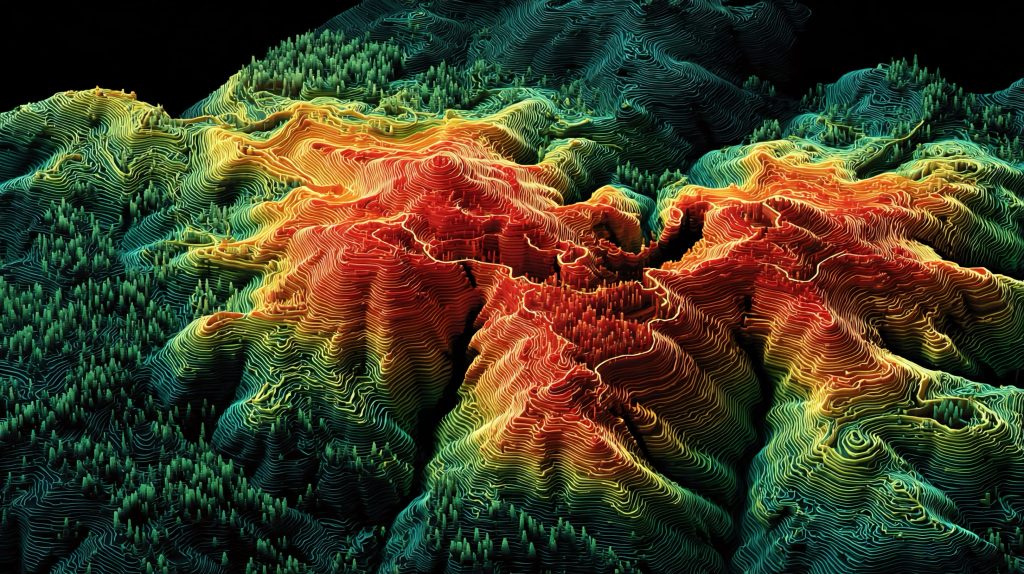
1. Relocation of Causality: External Potential
The evolution of application architecture is not a matter of shifting design trends. It is a physical shift in where the Source of Order (Boundary Condition) is located within a system.
Traditional engineering (Inside-Out) placed high potential within internal schemas. However, in a modern environment where complex resources are fully commoditized, order no longer originates from within.
- The New Proposition: Causality has migrated to the system’s exterior (User Touchpoints).
- The Principle: The density and flow direction of the “Point Cloud”—the User Journey—acts as the Principle of Least Action, governing the system’s structure.
2. Software as a Dissipative Structure
Much like dissipative structures in thermodynamics, software is an open system that takes in energy (user input), processes it, and exhausts it.
- Decay of Internal Order: Internal structures (schemas) that do not align with external input consume excessive energy—manifesting as technical debt—and eventually collapse.
- Self-Organization by Gradient: In the vector field drawn by the behavior of large numbers of users, the “path” of least resistance becomes the established structure.
The Engineer’s Role: Shifting from “Creating Structure” to “Defining the Gradient” traced by the Point Cloud.
3. Hierarchical Necessity and Incompleteness
Layered Architecture is a logical constraint. As Gödel and Turing demonstrated, a layer’s logic cannot be completed within itself. Higher layers (Context) determine the constraints of lower layers (Implementation).
- UX/UI (Energy Inlet): The Potential Source. Depends entirely on the external environment.
- Schema / Type (Boundary Condition): The Equipotential Surface. Depends on UX.
- Logic / Implementation (Relaxation Process): The Energy Dissipation Path. Depends on Schema.
Once the UX is decided, the internal system issues—both code and database—converge mathematically as an optimization problem.
4. Structural Proof in Robotics
In Reinforcement Learning (RL), a quadruped robot acquires the ability to walk not because an engineer described the gait, but because the following were defined:
- Physical Constraints (Boundary Conditions)
- Reward Function (Potential Gradient)
- Spatial Topology Observation (Point Cloud)
The behavior is inevitably derived from the structure (Emergence). Software development is identical: by defining the appropriate rewards (user goals) and topology (screen transitions), the optimal implementation is geometrically determined.
5. Migration of Structural Dominance (1990s–2020s)
The “Origin of Potential” has shifted through three distinct phases:
- Phase 1: ER (Entity-Relationship) Driven
- Phase 2: API-First
- Phase 3: UX (Journey) Driven
6. Selective Pressure on the Tech Stack
The rise of TypeScript and Tailwind CSS is an adaptation to this “External Structural Determination.”
- TypeScript (Virtual Schema): The old causality was DB → Backend → UI. Today, it is reversed: UI Type → Backend Requirement. TypeScript fixes the Envelope Surface of possible states before physical storage is even finalized.
- Tailwind CSS (Atomic Fluidization): Treating the UI as an “Atomic Point Cloud” allows the system to re-stabilize immediately in response to local potential changes, bypassing the friction of centralized global CSS.
7. The Engineering Process of Journey-Driven Development (JDD)
JDD follows these physical steps to focus resources on value-generating interfaces:
- Define the Point Cloud: List all observable user action states.
- Fix Boundary Conditions: Lock the stable journey into a “Type.”
- Determine the Gradient: Identify high-entropy points (drops/errors) and correct the potential slope.
- Implement Sedimentation: Place the minimum backend structure necessary to satisfy the Type “post-hoc.”
Conclusion: Submission to the Gradient
The notion that “Data defines the App” is a relic of resource scarcity. In modern systems:
- The Journey is the Energy Inlet driving the system.
- The Algorithm is the Relaxation Path (how water flows).
- The Data is the Sediment (what remains after the flow).
Outside-In design is no longer a choice; it is the only solution in the age of Point Clouds and Potential Fields.