

When Secondary Value Exceeds Primary Value|Gaining Gold as a By-Product of Copper
— In Luxury, Rare Cases Where Secondary Value Exceeds Primary Value
When the prices of large tangible assets—watches, yachts, jets, real estate, and artworks—scale from tens of millions of dollar to billions or even hundreds of billions, they ultimately diverge into two distinct paths.
Tier 1: Assets Whose Secondary Value Surpasses Their Primary Value
These assets form a gravitational center—foundational stones upon which surrounding value accumulates.
- Their value can double or increase immediately after being purchased new at an official boutique.
- They are highly inflation-resistant and reliably double in monetary value over a decade.
- Gold and gold-derived products sometimes fall into this category.
Tier 2: Assets Whose Secondary Value Falls under Their Primary Value
Here, wealth—like high potential energy—dissipates and cannot be retained.
- They lack inflation resistance; value erodes over time.
- 99% of UHNW individuals and billionaires end up stuck at this endpoint.
A critical point is that both Tier 1 and Tier 2 assets appear alike from the outside: people gather, businesses operate for years, and the surfaces look similar. Without evaluating them by value, time, and density, the difference cannot be seen.
Upper Price Limits by Tangible Asset Category
- Wine: up to around a million
- Bags, Cars: up to several million
- Watches: up to tens of millions
- Art, yachts, jets: up to hundreds of millions
- Real estate: hundreds of millions per unit; billions for large lots
- Startups / equity: up to tens of billions
Yet, when measured through the lens of value, time, and density, most tangible assets belong to Tier 2—assets that lose value the moment they are purchased.
In contrast, among the many categories of tangible assets, a tiny fraction—one in a billion, part per billion(ppb)—possess the same extraordinary property as gold: their value never declines. Just as natural gold occurs at ppb levels, rare industries such as haute horlogerie or tech consumer products in equity markets achieve “concentrations” comparable to the 50 ppm grade of Japan’s world-class Hishikari Gold Mine. Hishikari Mine in Kagoshima, Japan, is one of the world’s highest-grade gold mines, boasting an exceptional concentration of around 40 ppm—roughly a ten-thousand-fold enrichment over the natural crust. Industries such as haute horlogerie or tech consumer products in the equity markets resemble such high-grade gold deposits, where value density reaches similarly rare levels.
However, even within a gold-grade industry, a probability of one in a billion often improves only to one in a million. In the end, rigorous screening is still required—just as it is in actual gold mining.
Most Assets Are Cheaper on the Secondary Market
- A new Toyota Alphard can cost up to ¥10M; a used one can be acquired for under ¥5M.
- Series A/B startup shares are expensive; late-stage distressed equity can be obtained for almost zero.
Even luxury watches—aside from haute horlogerie:Patek Philippe, Audemars Piguet, Richard Mille, and Rolex—can be purchased at 40–80% off on the secondary market, even in near-mint condition. There are many products for which there is almost no rational reason to buy at primary retail.
Even certain Patek models decline in secondary value. Tier 1 signature pieces, however, resemble Toranomon Hills Residence reference in real estate in Japan—a central anchor promised abundant future development, with 50-year plans already in motion.
Tier 2 assets resemble cemeteries—essential, but non-transferable and incapable of value creation. Aoyama Cemetery in Minato may increase in price due to surrounding land appreciation like Toranomon Hills, but this is not the “organic value birth” that defines Tier 1.
Tier 1 Assets Are Like Gold Born in a Kilonova
Everything else is “non-gold”. Because these non-gold assets lack intrinsic elemental energy, they lose energy relative to gold.
Most watches, art pieces, yachts, jets, and equities function more like graveyards—absorbing energy from capital holders rather than generating it. Even when they appear to be appreciating, the energy is not rising energy but declining energy, akin to death rather than birth.
This is why artists who die young sometimes rise in value—this represents a Tier 2 peak, not Tier 1 generativity.
At boutiques or auction houses, Tier 1 and Tier 2 look almost alike in appearance and price. Many Tier 2 items even reach tens of millions. Both hold high potential energy at the time of purchase—but differ entirely in how they generate energy over time.
- Tier 1 naturally appreciates without requiring any effort.
- Tier 2 naturally falls, just like a ball dropped from a tower.
- It requires enormous effort merely to prevent value from declining—yet usually fails.
Copper and Gold: A Perfect Analogy
Copper ore that contains 1 kg of gold per 100 tons will yield the same monetary value from 1 kg of gold as from 100 tons of copper.
Yet:
- Copper requires 10 truckloads, dozens of workers, and significant logistics.
- Gold can be carried alone in a compact car with only one driver.
Copper fluctuates in price and carries operational risk across mining, transport, refining, and shipping. Gold, however, precipitates naturally during copper refining, making it essentially “free” to obtain—pure by-product economics.
This is why gold’s embedded energy is fundamentally higher: retrieving it is surprisingly effortless.
Thus:
- 1 kg of Tier 1 gold
- = 100 tons of Tier 2 copper
Their market price may match, but:
- Gross margin of gold ≈ 90%
- Gross margin of copper ≈ 10%
A clear illustration of two assets with entirely different internal structures appearing identical externally.
During copper electrorefining, gold does not dissolve—it automatically precipitates into anode slimes and can be recovered with near-zero cost.
Tier 2 “Super” Assets: Bridges to Tier 1
Some Tier 2 assets have a bridge property—Tier 2 Super—allowing one to obtain Tier 1 assets as by-products.
Sumitomo became Japan’s second-largest zaibatsu(conglomerate family office) by acquiring copper mines—and with them, gold mines “as a bonus”. Mitsubishi and Mitsui similarly secured rights to copper concentrate imports (e.g., from Chile), enabling gold production as a by-product, becoming Japan’s top and third-largest conglomerates.
The decisive factor separating Mitsubishi / Sumitomo / Mitsui from others was simply: whether they were positioned to obtain gold—Tier 1—as a natural by-product.
Ore Comparison
Element Concentrations
| Element | Crust | Typical Ore | Maximum |
|---|---|---|---|
| Copper | 50–70 ppm | 0.3–1% | 2%+ |
| Silver | 70–100 ppb | 50–500 ppm | 1–5 ppk |
| Gold | 1–4 ppb | 1–5 ppm | 50+ ppm (e.g., Hishikari) |
Enrichment Factors (Crust → Ore)
- Copper: 50–200×
- Silver: 500–5,000×
- Gold: 1,000–50,000×
Gold Alloy Examples
| Type | Au | Ag | Cu | Pd/Ni | Characteristics |
|---|---|---|---|---|---|
| 18K YG | 75% | 12.5% | 12.5% | — | Most natural gold color |
| 18K RG | 75% | 2.5–5% | 20–22.5% | — | Rose tone |
| 18K WG (Pd) | 75% | 5–10% | Small amount | Pd 10–15% | Soft white, high-end |
| 18K WG (Ni) | 75% | 5–10% | 5–10% | Ni 10–15% | High strength but allergenic |
Rose gold and yellow gold reflect this idea of “obtaining gold as a by-product of copper”. Although silver mines can also yield gold, copper mining is far more efficient.
Real-World Production Examples
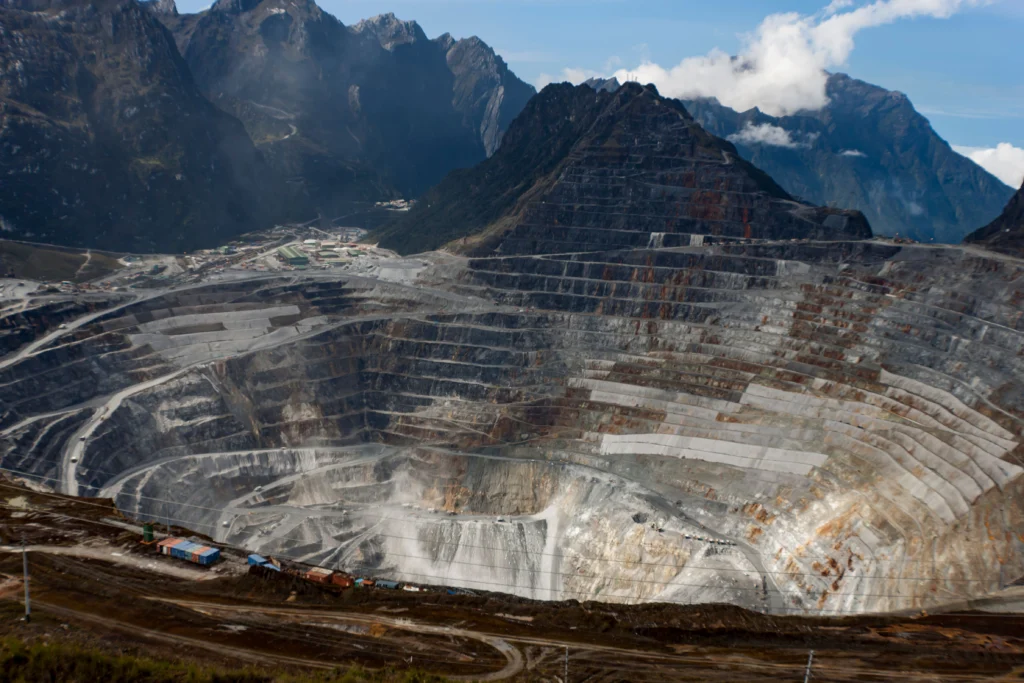
- Freeport-McMoRan’s Grasberg Copper-Gold Mine (Indonesia)
Contract area: 24,700 ha (247 km²)
Annual gold production: ~100 tons - Hishikari Mine (Kagoshima, Japan)
Area: 50 ha
Annual gold production: ~5 tons- How you can imagine just 50ha produce 500 million dollar per year. If you grow corn, it will be only less than 500K and potate for less than 5million
Iron Is Even More Concentrated
| Element | Crust | Ore | Enrichment |
|---|---|---|---|
| Iron | 5% | 30–60% | 6–12× |
| Copper | 50–70 ppm | 3,000–10,000 ppm | 50–200× |
| Silver | 0.07–0.1 ppm | 50–500 ppm | 500–5,000× |
| Gold | 0.001–0.004 ppm | 1–5 ppm | 1,000–50,000× |
However, gold does not have the property of occurring near iron, so it is almost impossible to obtain gold as a by-product of iron.
Since such cases only happen under extremely rare conditions—such as when a meteorite has fallen—iron cannot be considered a Super Tier 2 asset.
In the end, one should aim to become Tier 1—the position that ultimately yields gold.
One should become Tier 1—someone who acquires gold—as early as possible in life.
However, beginning from Super Tier 2, which looks almost identical to Tier 2 on the surface, and then obtaining Tier 1 as a by-product, is a strategy that aligns with the Least Action Principle—the principle of least action in physics.
Diamonds, rubies, and sapphires can all be artificially produced, which means they do not possess the Tier 1 characteristics that gold does.
However, certain categories—such as natural diamonds, Pigeon’s Blood rubies, Kashmir sapphires, or the Record Bale grade in merino wool—are effectively Super Tier 2: they represent levels of rarity and value density that artificial production cannot reach in a cost-efficient manner.
銅のついでに金を得る|プライマリー<セカンダリーの稀有な財
1点数千万円から数百億円までの価値のある時計、ヨット、ジェット、不動産、絵画などの大型有形資産の値段が1000万円、1億円、10億円、100億円、1000万円、1兆円とスケールして行った時に行き着く道は2通りある。
- Tier1 資産
- 重力の中心、土台、基盤となり、その周辺に価値が乗っていくことによってプライマリー価格よりもセカンダリー価格の方が高くなる有形資産
- 新品で直営店で買った直後に2倍〜10倍まで価値が増えることがある
- インフレ耐性があり、必ず10年で2倍の貨幣価値にはなる
- ゴールドおよびゴールドの派生商品
- 重力の中心、土台、基盤となり、その周辺に価値が乗っていくことによってプライマリー価格よりもセカンダリー価格の方が高くなる有形資産
- Tier2 資産
- 富という高い位置ポテンシャルが拡散し、プライマリー価格よりもセカンダリー価格の方が99%低くなる有形資産
- インフレ耐性がなく、インフレとともに(あるいはインフレ以上に)価値が減価していく
- UHNW、ビリオネアの99%がこの終点でスタック(停留)してしまう
- 富という高い位置ポテンシャルが拡散し、プライマリー価格よりもセカンダリー価格の方が99%低くなる有形資産
重要なポイントは、この2つの有形資産は似ているということだ。外形は人が集まり、事業が長年運営されている点で同じように見えるということである。「価値」「時間」「密度」というパラメータにより評価することなしに、この2つの違いを明らかにすることはできない。
- 有形資産カテゴリに応じて金額レンジのキャップがある
- ワインは数千万円周辺
- バッグは数億円まで
- 車は十数億円まで
- 時計は数十億円まで
- アート、ヨット、ジェットは数百億円まで
- 不動産は区分では数百億円まで。ロットでは数兆円まで
- スタートアップや株式投資は十数兆円台まで
- しかしながら「価値」「時間」「密度」という尺度を入れると、ほとんどの有形資産は買った瞬間に価値が下がる類型2のTier2資産カテゴリーに所属する
一方で、数ある有形資産のカテゴリの中で、10億分の1くらいの確率。まさに、地殻や海から取れるゴールドの割合がppb(part per billion)であるのと同様、価値が全く下がらないゴールドの性質と同様の性質を持った財がある。日本の鹿児島にある菱刈金山は世界トップで40ppm(part per billion)という1万倍くらいの濃縮度を誇るが、オートオルロジュリー(宝飾複雑時計)業界や株式市場におけるテックコンシューマープロダクツはこの40ppmのような濃度が実現する金鉱床のような産業である。しかしながら、金鉱床の産業にいたとしても10億分の1が100万分の1くらいしかならないため、結局スクリーニングしないといけないというのは同様である。
99.99%の資産はTier2である
ほとんどの財はセカンダリーで掴んだ方が安い。アルファードの新品は1000万円までかかる可能性があるが、アルファードの中古は500万円以下で手に入る。スタートアップのシリーズA,Bの株式は高いが、レイターステージまで待てば、資金繰りに詰まってほぼ0円で手に入れることもできる。
Tier1資産はOne in a Billionくらい稀である
Tier1は限定的である。Patek Philippe, Audemars Piguet, Richard Mille, Rolexのシグネチャモデルを除く高級時計はTier2である。セカンダリーで手に入れればほぼ新品同様だとしても40%引き〜80%引きで手に入る。店舗で買う理由がない商品もたくさんあるのである。パテックであってもセカンダリーが下がってしまうモデルはある。ティア1のオートオルロジュリーのシグネチャモデルについては虎ノ門ヒルズレジデンスのような、将来周辺にたくさんの大規模開発が約束されている中心エリアのようである。虎ノ門ヒルズを中心として周辺にどんどんレジデンスや商業ビルが立ち、向こう50年の計画が予定されている。
Tier2資産は必需品だとしても価値は上がらない
一方でティア2の財についてはそれ以上、機能性以上の価値がつかない墓地のようである。墓所は必需品ではあるものの、転売もできないし、価値が上がることもない。たまたま周囲の土地の単価が上がることによって副次的に土地の価値が上がる港区の青山霊園のような場所もあるが、その価値の値上がりはティア1のような「生まれる」ことによるバリューではない。
Tier1はゴールド、Tier2はゴールド以外
ティア1はまさにキロノバで生まれる金(きん)のようなものであり、それ以外の財は「金(きん)」以外である。金以外の財には財自体の元素としてのエネルギーが金に劣るため、相対的に金にエネルギーを取られてしまう。時計、アート、ヨット、ジェット、株式だとしてもそのほとんどは、資本家という高い位置ポテンシャルを持った集団からエネルギーを吸い取るだけの墓場である可能性の方が高いのだ。
Tier1とTier2はエネルギー生成の内部構造が全く異なる
仮に墓場なのに価値が上がっているように見えたとしても、それは「生まれる」「上がっていく」エネルギーではなく、どちらかというと「死ぬ」「落ちていく」エネルギーに近い。したがって、早死にのアーティストが評価されるというのはティア2の資産の再頂点を示しているのである。ティア1とティア2は店頭やオークション会場ではどちらも同じような見た目、同じような価格に見える。そしてティア2資産でも価格が数十億のものはたくさんある。そして、どちらも、買う時点では高い位置エネルギーを持つ。しかしエネルギー生成方法が違うため、「価値」「時間」「密度」というメガネで帰結を観察すると、ティア1は自然と上がっていくため、下がらないための努力は必要なく、価値を上げるための努力も必要がない。
ティア2資産カテゴリーは下がらないための努力をしてやっと価値が保全できるがそれも間に合わず、落ちるエネルギーを保持することができずに結局どんなに頑張ったとしても価値が下がることを食い止められないことの方が多い。
金は銅の100万倍以上の価値がある
銅山で取れる鉱石は100万分の1、ゴールドを含むことがあるが、100トンの銅に対して、1kgの金が取れるとして、100トンの銅と、1kgの金は同じ価格である。銅の精製プラントの主要収益源は金である。100トンの銅は10トントラック11回分の輸送費であり、ロジスティクスも数十人体制である。一方、1kgの金はプリウスのようなコンパクトカーでさえ運べるし、一人で運べる。銅は値上がりも値下がりもするため、100トンの鉱石を輸送し、精錬し、出荷するまでの一連のバリューチェーンにリスクが付随する。一方金は銅を生成する過程で自然と沈澱するため、「ついで」に取れる。
ゴールドはついでに手に入る。Tier1資産もついでに手に入る
金はそのエネルギー含有量が他の元素とは根本的に異なるため、金自体に莫大なエネルギーが潜んでおり、それを獲得するために使うエネルギーは思いの外「楽」なのである。
金と銅を比べると金はTier1、銅はTier2である。Tier1の金1kgと、Tier2の銅100トンは同じ値段である。しかし、金の粗利益が90%に比べて、銅の粗利益は10%である。全く別の内部構造を持ったものが、外径から見ると全く同じように見えるという良い例である。
銅(Cu 29)の分離で電極を利用するときに金(Au 79)が自動的に沈澱する。金や銀は電解アノードスライムから回収できる。(Gold Recovery from Electrorefining Anode Slimes)金は銅の電解精製では 溶解せずに沈殿する ため、直接的なコストほぼゼロで集まる。
Super Tier2はTier2とは違う
Tier2資産の中にも、Tier1資産をついでに得られる「ブリッジ」的な性質を持つTier2 Superのような資産がある。住友グループが日本2位の財閥になれたのは銅山を得て、そのついでに金山を得たからである。三菱も三井も、チリなどで銅鉱石のコンセントレートを買い付けする権利を確保して、ついでに金を生成できるようになり、日本1位、3位の財閥になった。三菱、住友、三井とそれ以外を分けるのは「ゴールド」というTier1資産を偶然得られるポジションになれたか否かである。
銀は1000ppmくらい算出するものであるが、銀以外の鉛(Pb)、亜鉛(Zn)、銅(Cu)、ヒ素(As)、アンチモン(Sb)、硫化鉱など毒性もあり工程が複雑になる。一方、銅は銅コンセントレートの30%くらいが銅である。金鉱石に対する銀鉱石は100倍の濃度があり、銀鉱石に対する銅鉱石はさらに100倍の濃度がある。(銅鉱石の1%程度が銅)
| 元素 | 地殻濃度 | 鉱床の典型濃度 | 最大例 |
|---|---|---|---|
| 銅 | 50–70 ppm | 0.3–1%(3–10 ppk) | 2%超 |
| 銀 | 70–100 ppb | 50–500 ppm | 1〜5 ppk |
| 金 | 1–4 ppb | 1–5 ppm | 50+ ppm(菱刈など) |
| 元素 | 地殻 → 鉱床での濃縮倍率 |
|---|---|
| 銅 | 約 50〜200倍 |
| 銀 | 約 500〜5,000倍 |
| 金 | 約 1,000〜50,000倍 |
| 種類 | Au | Ag | Cu | Pd/Ni | 特徴 |
|---|---|---|---|---|---|
| 18K YG | 75% | 12.5% | 12.5% | — | 最も自然な黄金色 |
| 18K RG(RG/PG) | 75% | 2.5–5% | 20–22.5% | — | 赤みのあるローズカラー |
| 18K WG(Pd系) | 75% | 5–10% | 少量 | Pd 10–15% | 高級WG、白さが柔らかい |
| 18K WG(Ni系) | 75% | 5–10% | 5–10% | Ni 10–15% | 強度高いがアレルギー注意 |
ローズゴールドやイエローゴールドは銅(Cu)のついでに金(Au)を得るというコンセプトが感じられる良いマテリアルである。銀鉱山から金を取るというやり方もあるが、銅鉱山から取る方が効率が良い。
金はとうもろこしの1万倍、じゃがいもの1000倍効率的に稼ぐ
Freeport-McMoRan が所有する インドネシアGrasberg Copper Gold Mineの鉱業許可区域(contract area) は24,700ヘクタール = 247 km²で、ここから毎年100トン近くの金が取れる。一方、日本の菱刈銀山ではたったの50ヘクタールでも金が年間5トンくらい取れている。
50ヘクタールでとうもろこしを育てても年商1億円である。じゃがいもを育てても年商10億円である。金を取れば、純利益で100億円超になる。じゃがいもの1000倍効率的である。
鉄は金、銀、銅よりもさらに取りやすく、地殻:5% 鉱床:30〜60%である。
| 元素 | 地殻濃度 | 鉱床濃度 | 濃縮倍率 |
|---|---|---|---|
| 鉄(Fe) | 50,000–60,000 ppm | 300,000–600,000 ppm | 6〜12倍 |
| 銅(Cu) | 50–70 ppm | 3,000–10,000 ppm | 50〜200倍 |
| 銀(Ag) | 0.07–0.1 ppm | 50–500 ppm | 500〜5,000倍 |
| 金(Au) | 0.001–0.004 ppm | 1〜5 ppm | 1,000〜5万倍 |
しかし、金は鉄の近くにいる性質を持っていないため、鉄のついでに金を得ることはほぼない。隕石が落ちたなどのパターンなどレアなケースである以上、鉄はSuper Tier2とは言えないのである。
Super Tier2からTier1資産をついでに得る戦略
人生の早い段階で金を得るTier1になるべきだが、Tier2と見た目そっくりのSuper Tier2から始めてTier1を得るという戦略がLeast Action Principle、物理の最小作用原理に沿っている。ダイヤモンド、ルビー、サファイアも人工的に生成可能な点で金のTier1性は有していない。ただし、ナチュラルダイヤモンド、ピジョンブラッドルビー、カシミールサファイア、メリノウールにおけるRecord Baleなど、人工ではコスト効率的にたどり着けないような部類のものはSuper Tier2と言えるだろう。